I stumbled upon Kaiping Diaolou many years ago when planning our first trip to China. Unfortunately, our schedule was tight, and we didn’t have time to visit this remarkable place.
This time, we couldn’t miss it. These unique houses are just a short trip away from China’s third-largest city and, contrary to what we expected, are not actually crowded with tourists.
There are Diaolou all across Guangdong Province. However, it is in Kaiping that you can find the best examples of these fortified towers. It can be somewhat confusing to figure out where to look for them, so we explain in detail how to plan your visit.
Origin of Diaolou
The first Diaolou appeared during the Ming Dynasty as defensive structures against bandits. However, it was in the early 20th century, during the Qing Dynasty, that they started popping up all over Kaiping and the rest of Guangdong.
During the 1920s and 1930s, many people from Kaiping and the surrounding areas emigrated to North America, Southeast Asia, and Australia. They would send money home, which was then used for the construction of these unique buildings.
Apart from serving a defensive purpose, they also showcased their owners’ success abroad. They were deliberately built tall, not only to protect against other people but also against the frequent floods.

Architecture
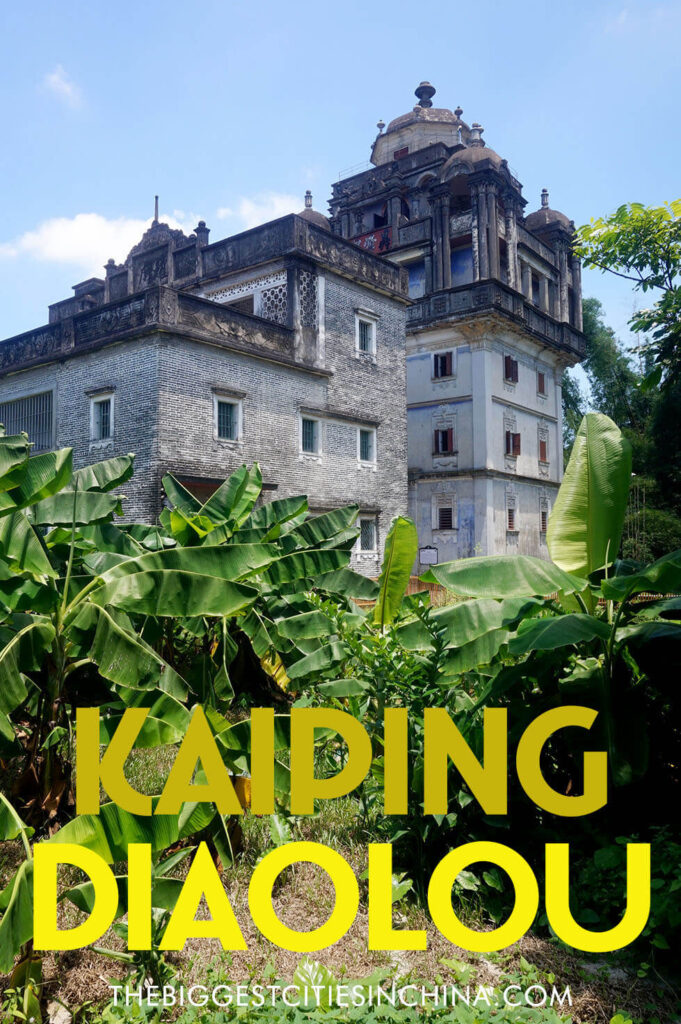
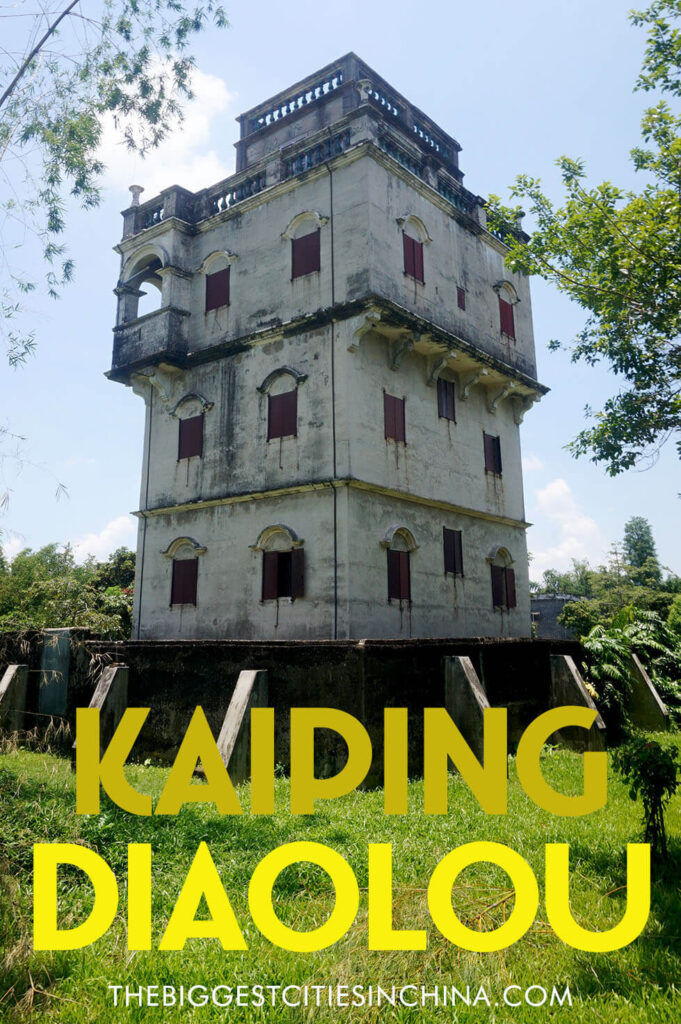
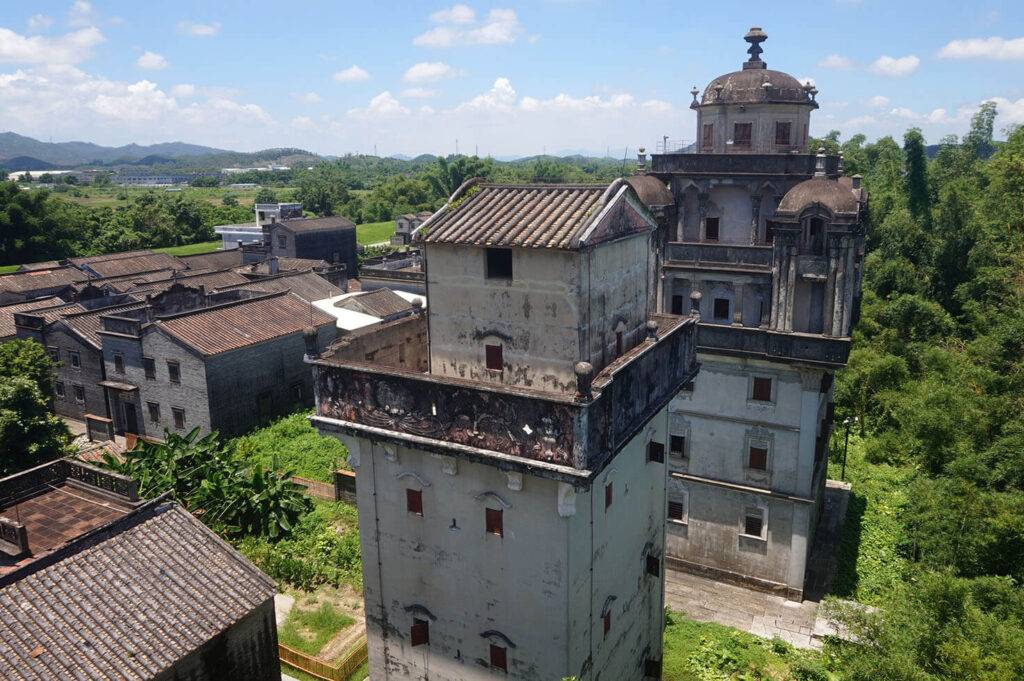
The word Diaolou means fortified tower. Most towers have between three and six floors. However, the tallest Diaolou, Ruishi Lou, has nine. The oldest examples were built from earth and wood. These materials were later replaced by brick, stone, and, eventually, reinforced concrete.
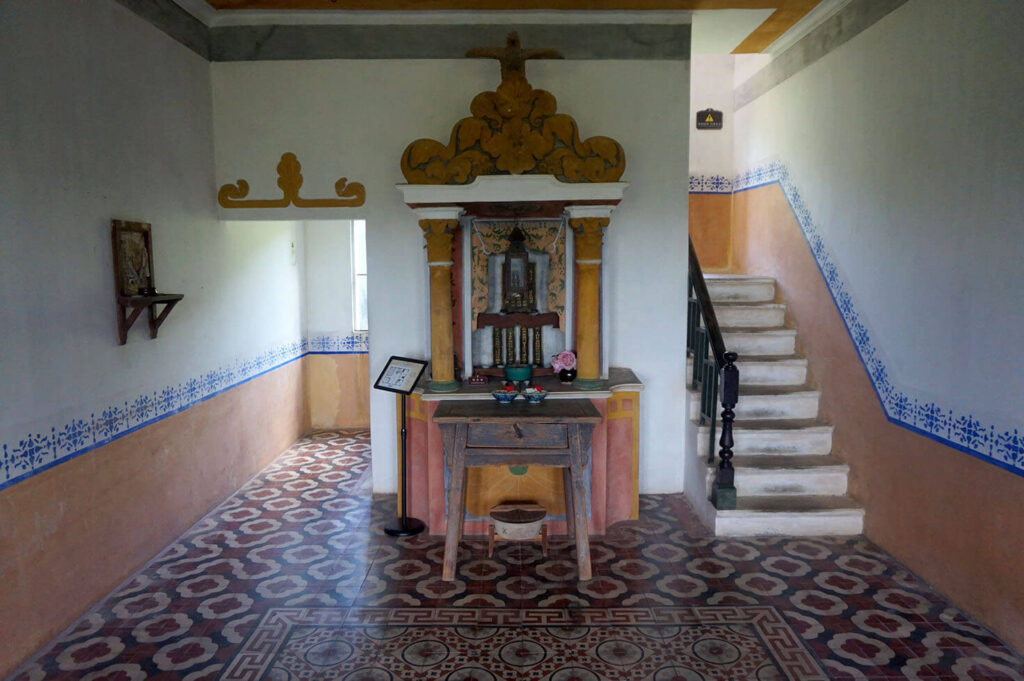
The architecture of Diaolou represents a harmonious blend of Chinese and Western architecture. You will find classical Greek or Roman columns, Gothic arches, Byzantine domes, and Baroque or Islamic decorations. Some houses still feature their original furniture, decorations, and personal belongings.
There are three main types of Diaolou. The communal towers, Zhong Lou, were built by several families. The residential towers, Ju Lou, belonged to a single family. The watchtowers, Geng Lou, were built to spot danger and warn the residents.
How to Visit
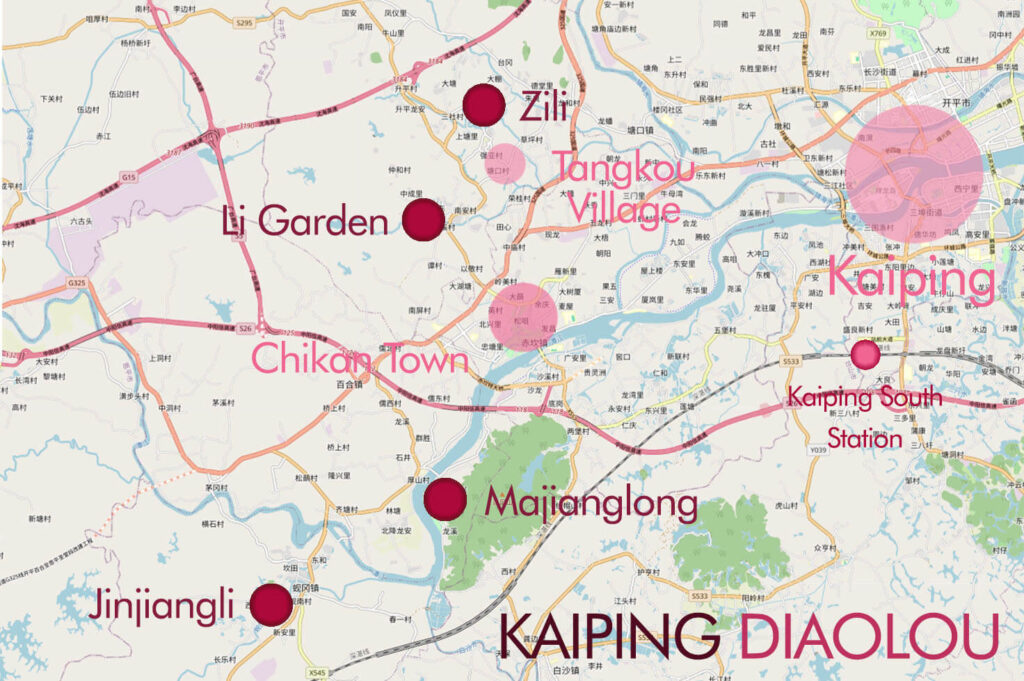
Understand the Area
The largest number of Diaolou can be found west of Kaiping city, in central Guangdong. Four of the main sites are UNESCO World Heritage sites called Kaiping Diaolou and Villages: Zili Village, Li Garden, Majianglong, and Jinjiangli. They require an entrance ticket.
You should spend as many days in the area as you can. We spent four full days here and visited these four Diaolou clusters in just two days.
We spent the remaining two days biking around the rice fields and visiting Chikan Ancient Town, Tangkou Village, and Kaiping City.
Arrive by Fast Train
It is fairly easy to reach Kaiping by fast train from Guangzhou. Frequent trains connect Guangzhounan (Guangzhou South) with Kaipingnan (Kaiping South) in just over an hour.
The trains are modern and reliable, but the ride is not especially scenic. Most of the journey takes you through urban areas, so you won’t see much of China’s natural scenery.
Because of its proximity to Guangzhou, the area is popular with locals, especially on weekends. So, try to visit on a weekday if possible.

Hire Local Drivers
Once you arrive at Kaiping South, you will need transportation from the station to your accommodation. The station is 9 km (5.5 miles) from Kaiping City and 15 km (9 miles) from Chikan Ancient Town.
We used Didi to find a driver, who arrived in just a couple of minutes. Unlike the area around Fujian Tulou, there are plenty of taxi drivers here, so you don’t need to hire your own driver to move around. You can simply use Didi to find a driver whenever you need one.
There are also buses connecting the different clusters, but they are very scarce, and it’s difficult to find their schedules. Also, check if your accommodation offers bicycles. They are a great way to get around.

Stay in the Middle of the Area
We spent a lot of time figuring out where to stay. Kaiping City seemed monotonous, and Chikan Town looked fake. So, we decided to stay in the middle of the area, in a historic Diaolou. It turned out to be the best decision.
Our Liyuan Daoxiang Diaolou Boutique Cultural Homestay is located inside an original watchtower and school complex. Our room had a large terrace overlooking the rice fields, the hosts were incredibly helpful, and they even offered complimentary bicycles. Li Garden was within walking distance of the hotel.
If you don’t want to be as isolated as we were, you should stay in the small village of Tangkoucun (Tangkou Village). It’s a beautiful village with several Diaolou, just a short distance from Zili Village. Our favorite place there is Lazy Cat Homestay.
If you want to enjoy views of Diaolou directly from your window, book a room at Floral Hotel · Fifty-third Degree Zhuxia Hotel, near Zili Village.

Which Villages to Visit
Zili Village
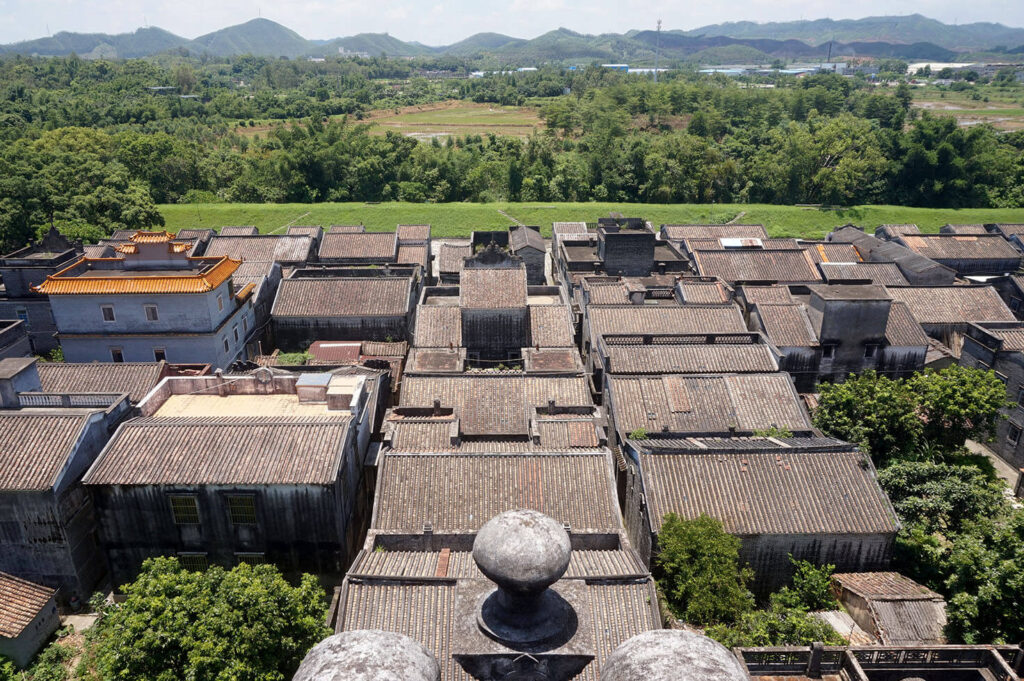
Zili Village is the most popular of all the locations. Founded in 1837, it consists of three villages belonging to the Fang family. There are 92 buildings, including nine watchtowers and six villas.
There is a main square, a small lake, a densely built neighborhood, and watchtowers scattered around the rice fields. We found a lovely coffee shop overlooking the rice fields in the middle of the village.
You can enter several watchtowers and climb all the way to the rooftops. The Mingshi Building is the most impressive one, but Yesheng, Lansheng, and Guansheng mansions are also worth visiting.

Li Garden (Liyuan)
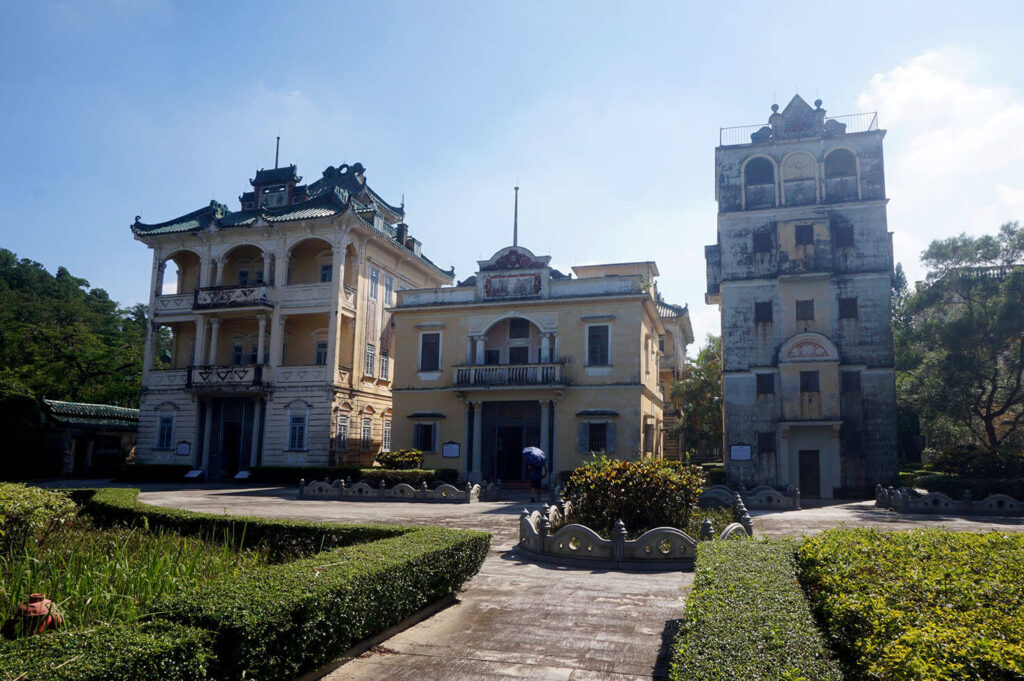
Li Garden is also quite popular. It was built in the early 20th century by Mr. Xie Weili, a wealthy Chinese man living in the USA. It is a great example of a classical Chinese garden with villas featuring European and American architectural styles.
The garden follows the concept of bridge, lake, and house. There is a large garden, a small garden, and a cluster of villas.
At Li Garden, you can climb several of its main buildings. There is also a small museum dedicated to printing and a nice café in a beautiful garden.
Majianglong
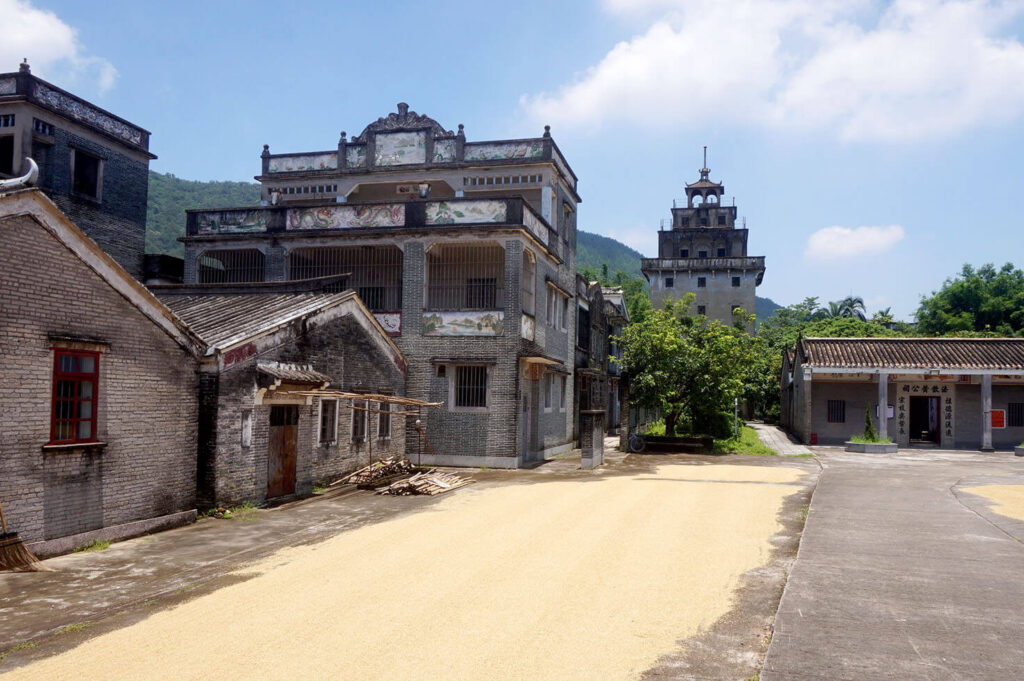
Majianglong is a bit farther away from the two previous locations. Perhaps that’s why there aren’t too many tourists here. It is a group of five villages, among which the most interesting is Yong’an Village, belonging to the Huang family.
This is our favorite place to see Diaolou. There are seven watchtowers and eight Western-style villas. Dense bamboo forests surround them, and you can see the mountains from the rooftops.
You can enter two watchtowers/villas: Jun Lu and Lin Lu. Both were built in 1936 by a wealthy Chinese Canadian, Guan Dinglin. There are no cafés or restaurants here, only a vending machine at the entrance.
Jinjiangli
The last place on our list is completely free of tourists. When we visited, we were literally the only tourists in Jinjiangli Village.
It’s a small, densely built village with stone houses and narrow streets. It is located next to a small river, so there are great views of the surrounding area.
The village is known for its three large Diaolou: Ruishi Lou (the largest Diaolou in China), Shengfeng Lou, and Jinjiang Lou. You have to pay an additional entrance fee to enter the first two. It’s well worth it!
Other Places to Visit
We spent a few hours around Chikan Ancient Town and didn’t particularly like it. True, there is some historic architecture, but it is complemented by fake old buildings, making everything look like a cheap Hollywood movie set. Plus, the entrance fee is quite expensive.
We also spent a few hours in Kaiping City. Huge residential neighborhoods occupy most of the city, but there is an interesting pedestrian area (Muchong Road) and a square connected to the other side of the river by a pedestrian bridge (Kaiping City Plaza). We loved the crumbling 1920 Dihaichao Bu neighborhood, which is soon to be refurbished.
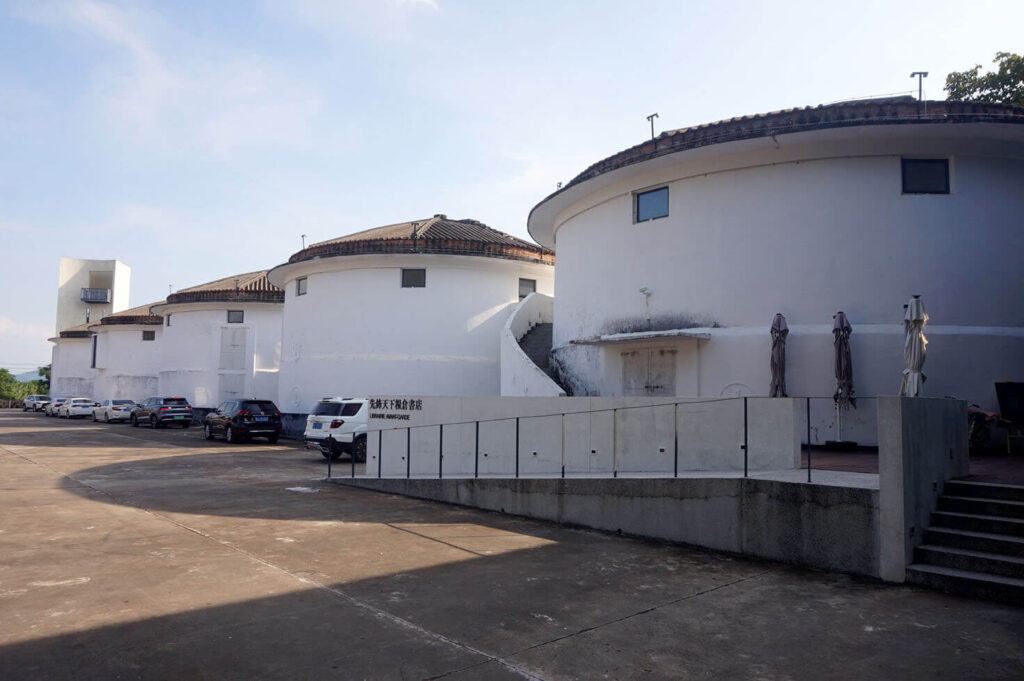
A place that pleasantly surprised us was Tangkou Village. There is a charming town center, several nice Diaolou, cute cafes and restaurants, and an impressive old granary that has been turned into a bookstore – Tangkouxu Granary. An absolute must!